SEO • Behind the Build
How HyperNest Labs grew to 13.1K monthly impressions with $0 in paid ads
This is the exact playbook we used to build HyperNest's organic search presence from zero: 200+ programmatic pages, operator-led insights, structured data across every page type, and a systematic Google Search Console indexing campaign. Real GSC numbers, no fluff. This is the same system we now offer clients.
Written by Aravind Srinivas, Former Head of Engineering at PyjamaHR and Founder & CEO of HyperNest Labs. All GSC data reflects hypernestlabs.com results from the 28 days prior to publication.
Table of contents
Starting from zero: just a landing page
When HyperNest Labs launched, the website was a single-page landing page. No blog, no service pages, no indexed content beyond the homepage. Google Search Console showed a handful of indexed URLs and single-digit weekly impressions.
We had no marketing budget. No paid ads, no sponsored content, no influencer outreach. The only channel we could invest in was organic search — and we had to build it entirely ourselves.
The decision was to treat SEO as an engineering problem, not a marketing problem. That meant building systems that could generate hundreds of indexed pages systematically, rather than manually writing one blog post at a time.
Programmatic SEO: 200+ pages from structured data
The highest-leverage move was building programmatic SEO pages — pages generated automatically from structured data templates that target real search queries.
For a consulting firm like HyperNest, the natural combinations are service × location, service × industry, service × technology stack, and service × startup stage. Every one of these combinations has real search volume. Someone in Austin searching for a “fractional CTO for healthcare startup” is a perfect HyperNest prospect.
We built dynamic routes in Next.js App Router:
/services/[service]/[industry]— service + industry combos (e.g.,/services/fractional-cto/healthcare)/locations/[city]— city-specific pages (e.g.,/locations/san-francisco)/industries/[industry]— industry hubs (e.g.,/industries/fintech)/technologies/[tech]— technology pages (e.g.,/technologies/nextjs)/compare/[competitor]— competitor comparison pages
Each page is unique — different H1, different body copy, different case study references, different FAQs — so Google treats them as genuinely distinct pages, not thin duplicates. The structured data in src/content/seoData.ts drives generation via generateStaticParams(), so every combination gets a static HTML page at build time.
Result: 200+ unique, indexed pages that would have taken months to write manually, built in a few days of engineering work.
Operator-led content: writing for buyers, not bots
Alongside the programmatic pages, we built a library of long-form insights articles targeting high-intent search queries. The key decision was to write about things we have direct operator experience with — acquisition stories, scaling patterns, hiring frameworks — rather than generic “how to hire a CTO” articles.
This is what Google's E-E-A-T (Experience, Expertise, Authoritativeness, Trustworthiness) framework rewards. Articles written by someone who was actually inside Rupa Health during the Series A, or inside PyjamaHR building the autonomous recruiter, carry signals that generic content farms cannot replicate.
Content clusters we built:
- Acquisition deep-dives (Rupa Health / Fullscript, OddsJam / Gambling.com) — capturing search traffic from founders and investors researching these companies
- Role definitions (what is a fractional CTO, founding engineer, forward deployed engineer) — informational intent that converts to service consideration
- Fractional CTO guides (hourly rates, best services, vetting questions) — capturing high-intent buyers comparing options
- AI startup playbooks (LLM architecture, AI MVP in 30 days) — reaching technical founders evaluating AI engineering help
Every insights article follows the same structure: hero with author attribution, table of contents with anchor links (for featured snippet eligibility), section IDs for smooth scrolling, and a related reading footer cross-linking to the case study and service page.
Structured data: every schema type, on every page
Structured data (JSON-LD) is one of the most underused technical SEO levers. Most startups either skip it entirely or implement only a basic Organization schema. We went significantly further.
Schema types implemented across hypernestlabs.com:
- Organization — root layout, with founder, logo, and sameAs social profiles
- Service / ProfessionalService — every service page (Fractional CTO, AI/LLM, Full-Stack, VAPT, SEO)
- Article — every insights page with author, publisher, datePublished, and about entity
- CaseStudy — every case study page
- FAQPage — auto-generated from FAQ content on all service pages
- BreadcrumbList — all insights and programmatic pages
- Person — Aravind Srinivas on the team page, with work history and expertise
The FAQPage schema is particularly valuable. Google uses it for FAQ rich results in search, which expand the search result footprint and improve CTR. Every service page on HyperNest now automatically generates FAQPage JSON-LD from its FAQ content array.
GSC indexing campaign: don't wait for Googlebot
Publishing a page doesn't mean Google will find it tomorrow. Googlebot crawls the web on its own schedule, and new pages on low-authority domains can wait weeks or months to get indexed.
The fix is a systematic Google Search Console URL Inspection campaign. GSC allows you to manually request indexing for individual URLs — up to 8-12 per day (the practical daily limit before hitting rate caps). We built a prioritized daily schedule and submitted every new page within 24 hours of publishing.
The priority order:
- New pages published in the last 24 hours
- High-impression pages not yet indexed (found via GSC Coverage report)
- Programmatic pages in high-value service/industry combos
- Updated pages with significant content changes
Running this campaign consistently is what drove the indexed page count from under 10 to 111 indexed pages within the first months of operating. For HyperNest, we documented the full schedule in a GSC-INDEXING-SCHEDULE.md file — a simple checklist of 8 URLs per day in priority order.
Results: 28-day GSC snapshot
These are real numbers from Google Search Console for hypernestlabs.com, 28-day window ending February 24, 2026:
The impressions curve is trending sharply upward — from near-zero in early January to 800-1,200 impressions per day by late February. Top queries include “hypernest”, “fractional cto hourly rate”, “founding engineer vs cto”, and branded fractional CTO terms.
Indexed pages: 111 and growing. Total unique queries generating impressions: 345. Paid ad spend: $0.
The CTR (0.7%) is deliberately low at this stage because many impressions come from informational content in positions 15-30. As those pages improve their average position, CTR will climb significantly. Average position 10.7 means many key pages are on the edge of page 1 — small improvements in E-E-A-T signals and content depth will push them into top-5 positions.
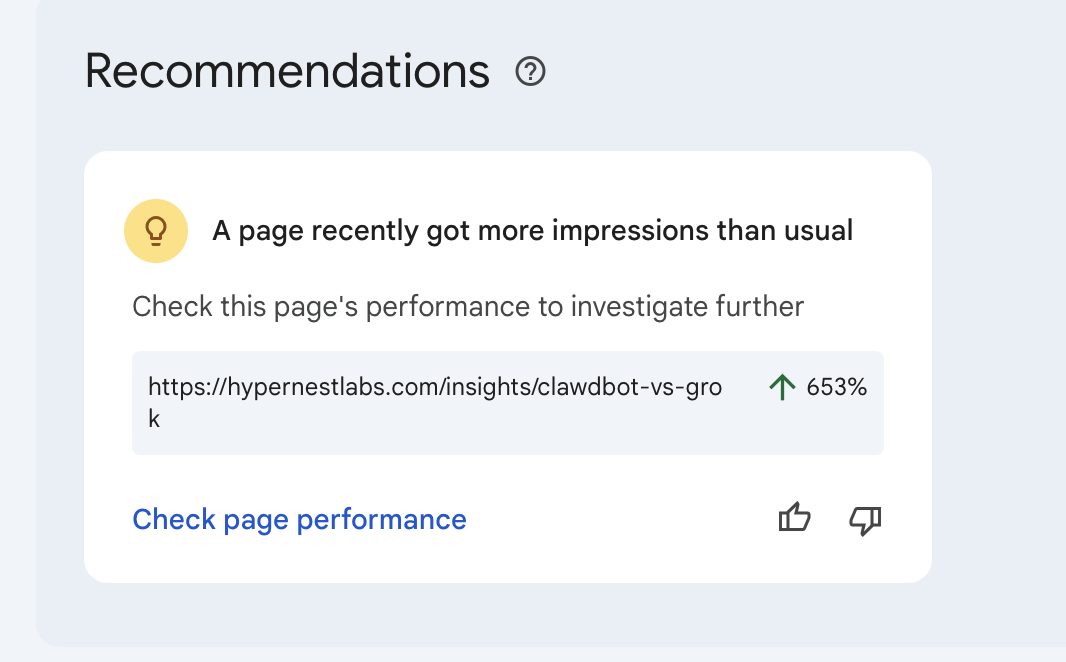
Google Search Console — hypernestlabs.com — Overview. 111 indexed pages, impressions trending sharply upward.
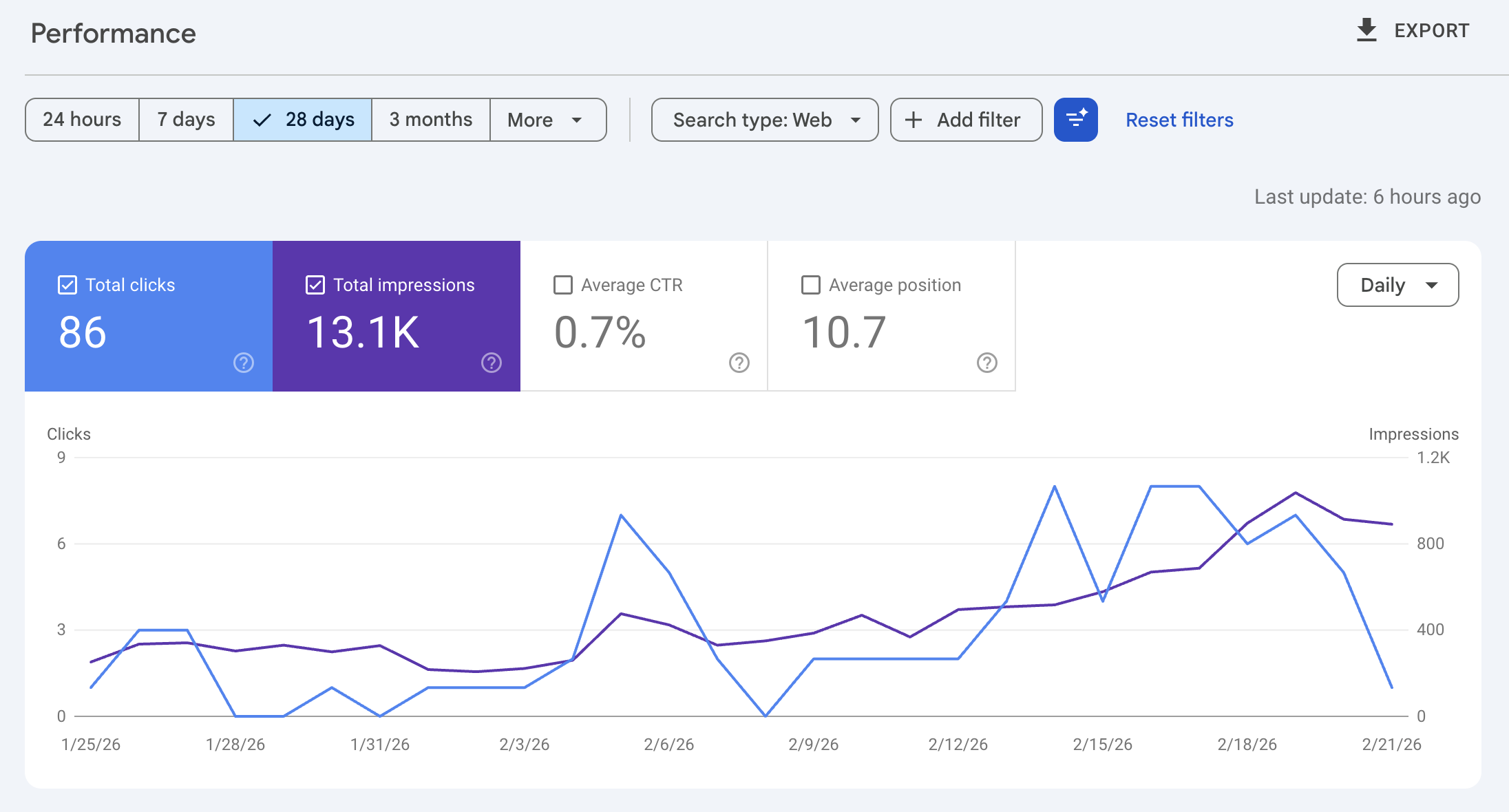
Google Search Console — hypernestlabs.com — 28-day window ending Feb 24, 2026. 86 clicks, 13.1K impressions, avg position 10.7.
Want this playbook for your startup?
We now offer the same SEO and content marketing system as a service. Technical SEO audit, programmatic pages at scale, structured data, and systematic GSC indexing — all executed by engineers who built it for their own products first.