SEO Case Study • Mobile App
PocketClear SEO case study: 0 to 2.63K monthly impressions competing against Mint and YNAB
A detailed breakdown of how HyperNest Labs built organic search presence for a brand-new iOS expense tracking app, using 250+ content pages, structured data, geographic targeting, and a systematic Google Search Console indexing campaign — with $0 in paid advertising.
Written by Aravind Srinivas, Former Head of Engineering at PyjamaHR and Founder & CEO of HyperNest Labs. All GSC data reflects pocketclear.app results from the 28-day measurement window in early 2026.
Table of contents
The challenge: entering a category owned by Mint and YNAB
PocketClear is a privacy-first iOS expense tracker. No bank connections, no ads, no data harvesting. A genuinely better product for privacy-conscious users — but entering one of the most crowded app categories in consumer finance.
Mint, YNAB, Monarch Money, Copilot, and dozens of funded competitors had spent years building domain authority, inbound links, and thousands of indexed pages. A brand-new app on a new domain had zero of that.
The constraints were clear: no paid advertising budget, no influencer partnerships, no PR. The only sustainable path to user discovery was organic search — and it had to be built from scratch.
Keyword strategy: avoid head terms, win on long-tail
The head terms — “expense tracker”, “budget app”, “personal finance app” — are dominated by Mint and YNAB with millions of backlinks and years of authority. Competing head-on for these terms on day one is a waste of energy.
The long-tail opportunity is enormous. Users searching for “mint alternatives” have already decided Mint isn't right for them — they're actively evaluating alternatives. Users searching “expense tracker for freelancers in London” have a specific problem PocketClear solves better than anyone.
We mapped three keyword categories:
- Competitor comparison queries — “mint alternatives”, “best YNAB alternative”, “Monarch Money vs X”. High buying intent, moderate competition.
- Use-case targeting — “expense tracker for couples”, “expense tracker for freelancers”, “expense tracker for students”. Niche intent, low competition, high conversion relevance.
- Geographic targeting — “expense tracker Australia”, “best budgeting app UK”, “expense tracker for expats in Singapore”. Near-zero competition, high specificity.
Content pillars: 250+ pages across three strategies
Pillar 1: Competitor comparison pages
We wrote direct comparison articles for every major competitor: PocketClear vs Mint, vs YNAB, vs Monarch Money, vs Copilot, vs Goodbudget, vs Simplifi, vs EveryDollar, vs Splitwise, vs PocketGuard. Each article is 1,500+ words with honest comparisons — we don't pretend PocketClear is perfect at everything, but we clearly articulate why the privacy-first, offline-first approach is better for a specific user type.
These pages also target “best mint alternative” and “best YNAB alternative” as H1 and throughout the body — capturing users who landed on a competitor's page and are now looking for a comparison.
Pillar 2: Geographic targeting
We built 100+ city and country pages: expense tracker for freelancers in New York, budget app for expats in Dubai, expense tracker for students in London. Each page is uniquely written — different local context, different currency considerations, different use-case framing.
This generates a massive content surface area that established competitors rarely invest in, because their teams don't have the bandwidth to write 100+ geo-specific articles. For PocketClear, it became the fastest path to indexed pages.
Pillar 3: Use-case and life-stage targeting
We targeted specific user personas and life situations: expense tracker for couples, for digital nomads, for first-job earners, for people moving to a new country, for H1B visa holders. Each article addresses a specific financial situation where PocketClear's privacy-first, no-bank-linking approach is a genuine differentiator.
Technical SEO: structured data and the sitemap
Technical SEO was done first, before publishing content. A page with great content but broken metadata doesn't rank well — and a missing sitemap means Google won't find new pages.
Structured data implemented:
- SoftwareApplication schema on the homepage with AggregateRating, Offers (free and Pro tiers), screenshot list, and feature descriptions. This enables rich results showing star ratings in search.
- FAQPage schema on all pages with 8+ Q&As each. FAQ rich results expand the search result footprint significantly.
- Article schema on every blog post with author, publisher, datePublished, and mainEntityOfPage.
- BreadcrumbList schema on all blog posts matching the visual breadcrumb (Home → Blog → Article).
Sitemap strategy: Priority tiers drive how often Googlebot returns to crawl each page. Homepage at 1.0 (weekly), comparison pages at 0.85 (monthly), geographic pages at 0.6 (monthly). The sitemap.xml lists 250+ URLs in priority order so Googlebot knows where to focus.
Every page has: canonical URL, meta title under 60 characters with primary keyword, meta description under 160 characters with a clear value proposition, proper heading hierarchy (H1 → H2 → H3), alt text on all images, and lazy loading for above-the-fold performance.
GSC indexing campaign: get indexed in days, not months
After publishing 250+ pages, the next problem is getting Google to actually index them. On a new domain, Googlebot may take weeks to discover and index new pages organically.
The solution: Google Search Console URL Inspection. Go to GSC → URL Inspection → paste the URL → “Request Indexing”. Google will crawl and index the page within hours or days rather than weeks.
The practical limit is about 8-12 URLs per day before hitting rate caps. We built a structured daily schedule — a simple checklist document with 8 URLs per day, prioritized by:
- Newest pages (submitted within 24 hours of publish)
- High-impression pages showing in GSC but not yet indexed (Coverage → “Discovered - currently not indexed”)
- Comparison pages (highest traffic potential per page)
- Geographic pages in high-volume markets
Running this consistently over 60-90 days is what drove PocketClear from 0 to 105 indexed pages. It's not glamorous, but it's one of the most impactful things you can do for a new site.
Results: 28-day GSC snapshot
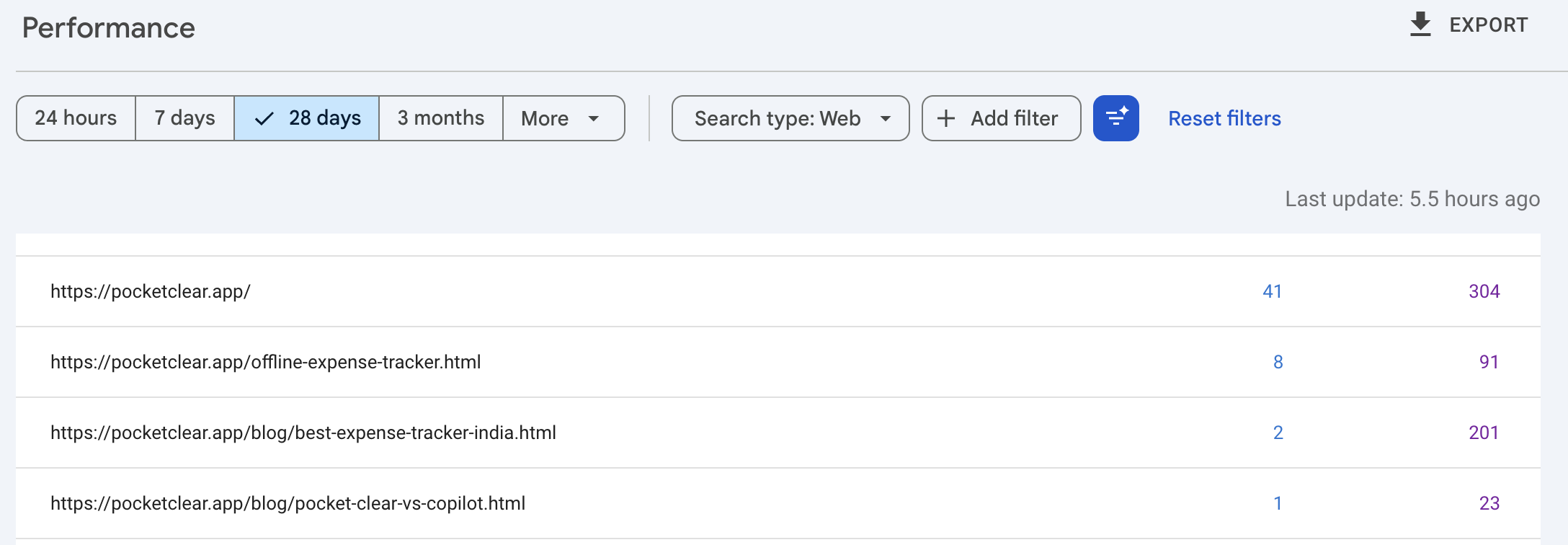
The 28-day Google Search Console data for pocketclear.app:
- 105 indexed pages (up from 0 at launch)
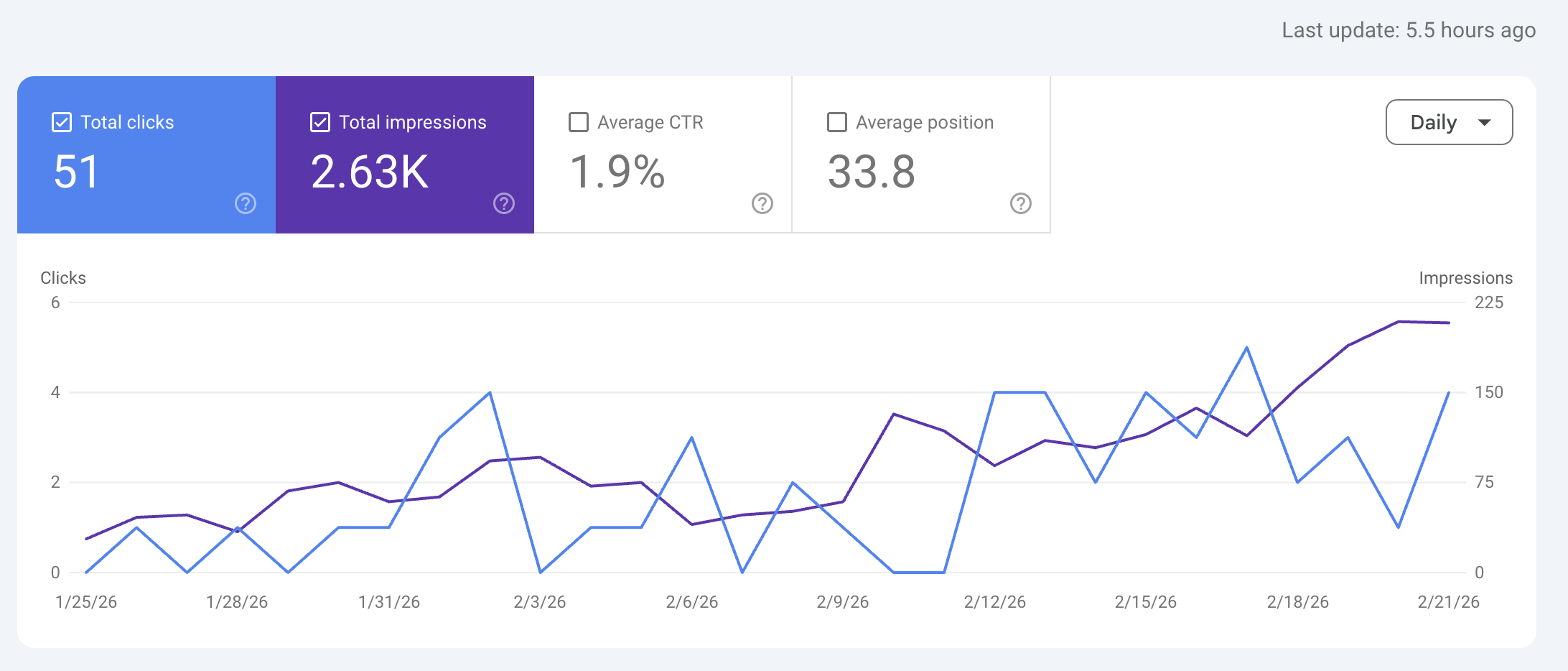
- 2.63K total impressions in 28 days
- 51 total clicks with 1.9% CTR
- 284 unique queries generating impressions
- Top queries: “pocket clear app” (9 clicks, 23 impressions), “pocket clear” (4 clicks), “mint alternatives” (44 impressions), “travel expense tracker app” (38 impressions), “best expense tracking apps” (24 impressions)
Google Search Console — pocketclear.app — Overview. 0 to 105 indexed pages (green line trending up). Breadcrumb and FAQ enhancements valid.
Google Search Console — pocketclear.app — 28-day performance. 51 clicks, 2.63K impressions, 1.9% CTR, avg position 33.8.
Google Search Console — pocketclear.app — Top queries. Ranking for “mint alternatives” (44 impressions), “travel expense tracker app” (38 impressions), 284 unique queries total.
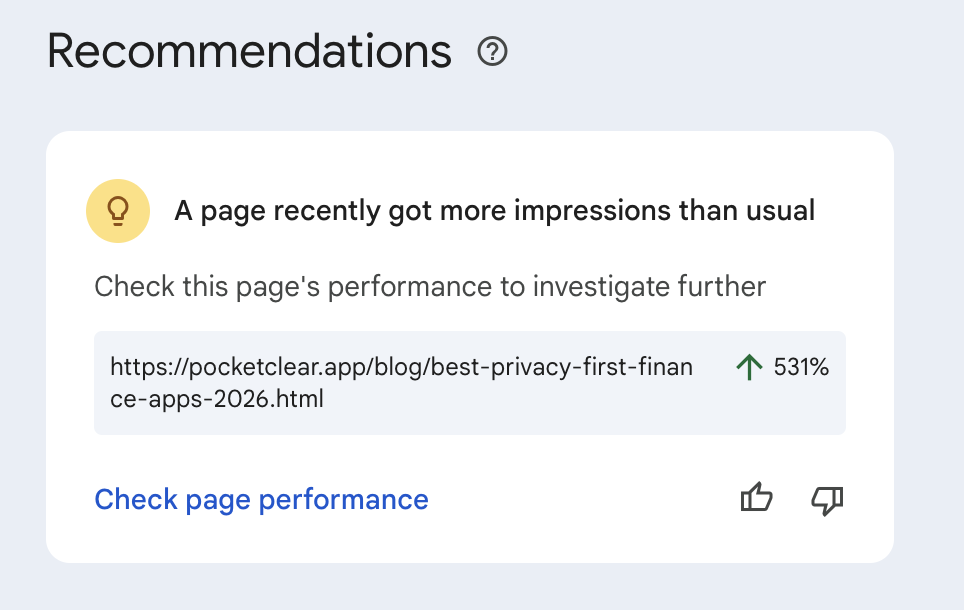
The impressions trending upward in the chart is the key signal. Early SEO for a new domain looks like slow growth that suddenly accelerates — as more pages get indexed, as domain authority builds from internal linking, and as Google gains confidence in the site's quality signals.
Frequently asked questions
How long does SEO take for a new mobile app?
PocketClear started showing GSC impressions within the first 30 days. Within 90 days, 105 pages were indexed and ranking for competitive keywords. Generally, expect 60-90 days before seeing meaningful impressions, and 3-6 months before consistent organic clicks.
Can a new app rank against Mint and YNAB?
Yes — on long-tail queries. Established brands dominate head terms, but comparison and niche use-case queries are far less competitive. PocketClear ranked for 'mint alternatives', 'travel expense tracker app', and 'expense tracking app Australia' within 90 days.
What is the most effective SEO strategy for a consumer app?
The highest-leverage content types are: competitor comparison pages (high buying intent), use-case targeting (expense tracker for freelancers, couples), geographic pages (expense tracker for [city/country]), and structured data (SoftwareApplication schema with AggregateRating).
Do I need to connect my app to a keyword tool?
Keyword tools help, but the most important starting point is your competitor's ranking queries. Go to GSC for any competitor site (if you have access), or use a tool like Ahrefs/Semrush to see what's driving traffic to Mint or YNAB's blog. That's your content roadmap.
Want these results for your app?
HyperNest Labs now offers SEO and content marketing as a service — using the exact playbook we built for PocketClear. Technical audit, content strategy, 250+ pages, structured data, and GSC indexing.