Growth Strategy • Organic SEO
Zero to organic growth with no paid ads: a startup playbook
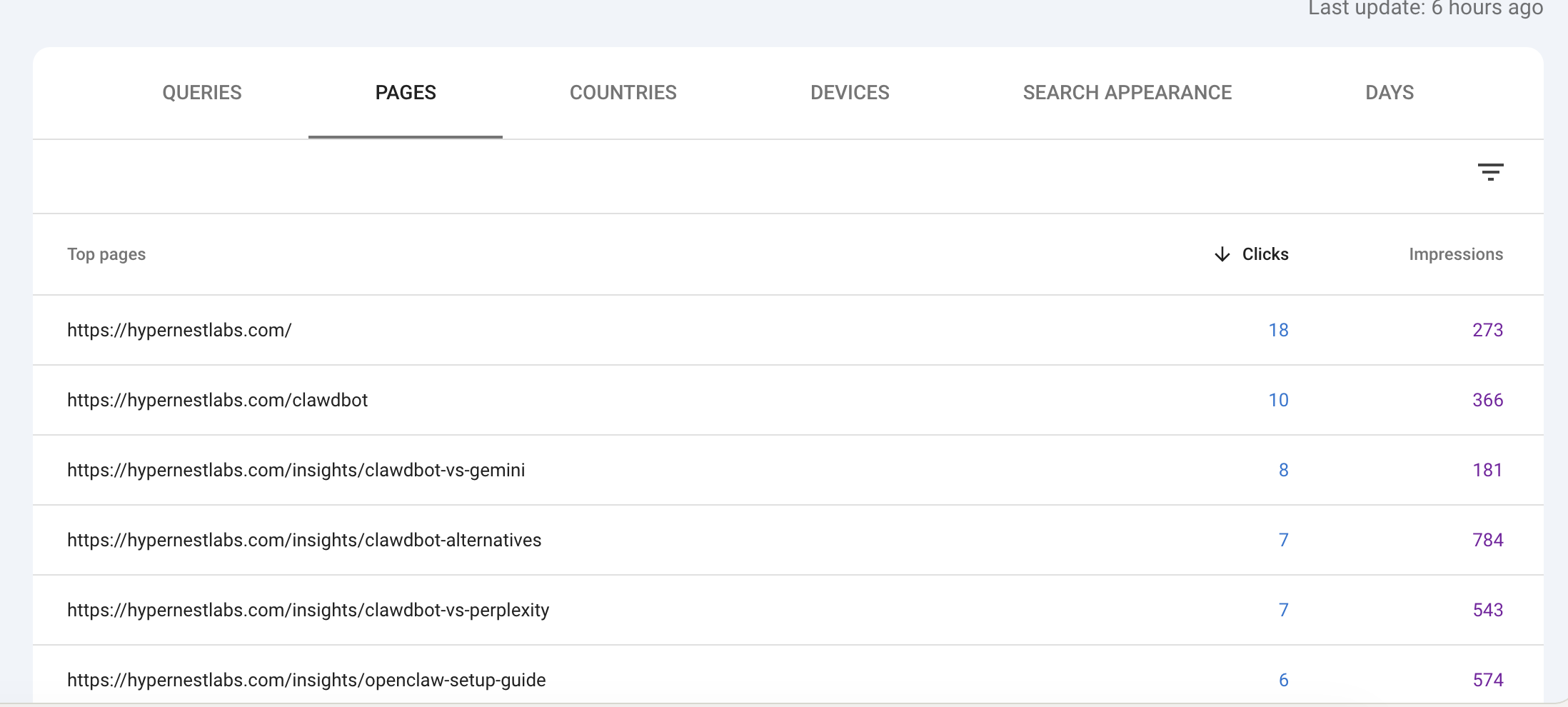
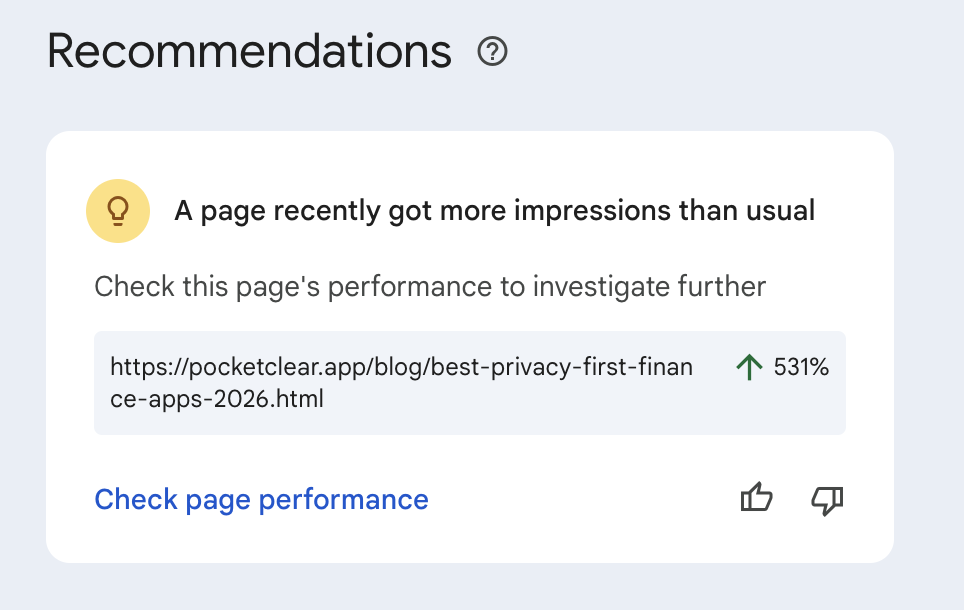
We grew HyperNest Labs to 13.1K monthly impressions and PocketClear to 2.63K monthly impressions — both with $0 in paid advertising. This is the compounding organic growth playbook: why SEO is the best investment a bootstrapped startup can make, and how to execute it without a marketing team.
Written by Aravind Srinivas, Former Head of Engineering at PyjamaHR and Founder & CEO of HyperNest Labs. All data reflects real GSC performance from early 2026.
Table of contents
Why organic SEO, not paid advertising
Paid advertising is a faucet. Turn it on, get traffic. Turn it off, get nothing. The moment you stop spending, the traffic stops. For bootstrapped startups or those watching runway, this is a dangerous dependency.
Organic search is an asset. A blog post you publish today can rank and generate traffic for years. A programmatic city page generates leads every month without ongoing marginal cost. The work you do in month 1 compounds through month 12 and beyond.
The other problem with paid ads at early stage: you don't know your customer yet. Pouring money into Google Ads before you've validated messaging, positioning, and conversion funnel burns cash without generating learning. Organic content forces you to write down who your customer is and what problems they care about — which is valuable product thinking regardless of SEO outcomes.
The right framing: paid ads are for accelerating a proven acquisition channel. Organic SEO is for building a durable growth asset. Startups that invest in organic early have dramatically lower CAC over their lifetime.
The compounding curve: why SEO feels slow, then doesn't
The most common objection to SEO: “it takes too long.” This is true in the early weeks, and false over any 6-12 month horizon compared to the cost of paid alternatives.
Organic growth follows an exponential curve, not a linear one. The first 30-60 days look flat: a few pages indexed, single-digit weekly impressions. Then something shifts. More pages get indexed. Internal links start passing authority. Google starts trusting the domain. Impressions double, then double again.
HyperNest's GSC data shows this exactly. The impressions chart from the past 90 days shows near-flat through December, then a pronounced upward curve through January and February — reaching 800-1,200 daily impressions by late February. The pages published in December started contributing in February.
PocketClear shows the same pattern. The first pages published and indexed saw impressions within 2-4 weeks. By month 3, the cumulative effect of 105 indexed pages — each contributing small amounts of impression share — adds up to 2.63K impressions per 28 days and a trend line still pointing up.
The insight: start SEO earlier than you think you need to. The compound returns you'll see at month 6 are entirely dependent on the work you did at month 1.
Five pillars of zero-budget organic growth
1. Technical SEO foundation
Before writing a word of content, fix the plumbing. Missing canonical URLs, broken sitemap, no structured data — these issues suppress your entire site's ranking potential. A technical audit typically takes 2-4 hours and unlocks everything that follows.
2. Programmatic content at scale
Build systems, not individual articles. Programmatic SEO generates 200+ unique indexed pages in the time it takes to manually write 10. City pages, industry pages, use-case pages, comparison pages — all valuable, all scalable. Read our guide on programmatic SEO.
3. Operator-led thought leadership
Write about things you have direct experience with. The most valuable SEO content is E-E-A-T content — Experience, Expertise, Authoritativeness, Trustworthiness. A post about scaling a Series A engineering team, written by someone who actually did it, outperforms generic agency content every time. These articles also build brand authority that converts readers into leads.
4. Structured data (JSON-LD)
Structured data is invisible to readers but highly visible to Google. FAQPage schema generates expanded FAQ results in search — dramatically increasing your result's footprint and CTR. Article schema signals authorship and publication date. SoftwareApplication schema enables star ratings for apps. All of this is free; it just requires implementation.
5. Systematic GSC indexing campaign
Publishing isn't enough. Use Google Search Console URL Inspection to manually request indexing for every new page within 24 hours of publishing. Run this as a daily routine — 8 URLs per day, prioritized by content value. This is the difference between pages that get indexed in days and pages that wait weeks.
Proof: our own GSC data
HyperNest Labs (hypernestlabs.com) — 28 days
PocketClear (pocketclear.app) — 28 days
Where to start: a 30-day organic growth sprint
If you have $0 for marketing and want to build organic growth, here is the 30-day starting sequence:
- Week 1: Set up Google Search Console, submit your sitemap, run a technical audit (meta tags, canonicals, structured data gaps). Fix the top 5 issues.
- Week 2: Keyword research. Map out your top 50 search queries across 3-4 intent categories (informational, comparison, transactional). Identify your competitors' top ranking content.
- Week 3: Build your first programmatic SEO pages. Identify 2-3 dimensions (city, industry, use case) and generate 50+ unique pages from structured data.
- Week 4: Publish your first 5 long-form articles targeting your highest-priority keywords. Start the GSC indexing campaign — 8 URLs per day, every day.
This is the exact sequence we ran for both HyperNest and PocketClear. It's not secret knowledge — it's consistent execution of the fundamentals. The compounding returns show up in month 2-3.
Want HyperNest to run this for your startup?
We offer the full organic growth playbook as a managed service: technical audit, programmatic pages, content strategy, structured data, and GSC indexing campaign. Same system we used to grow two of our own products with $0 in paid ads.